महत्वपूर्ण जानकारी
आयतन:0.35 m³
न्यूनतम ऑर्डर मात्रा:200起订
कुल वजन:0.35 kg
वितरण समय:1周内
आकार:L(7)*W(7)*H(7) cm
नेट वजन:0.062 kg
उत्पाद विवरण
Product Overview
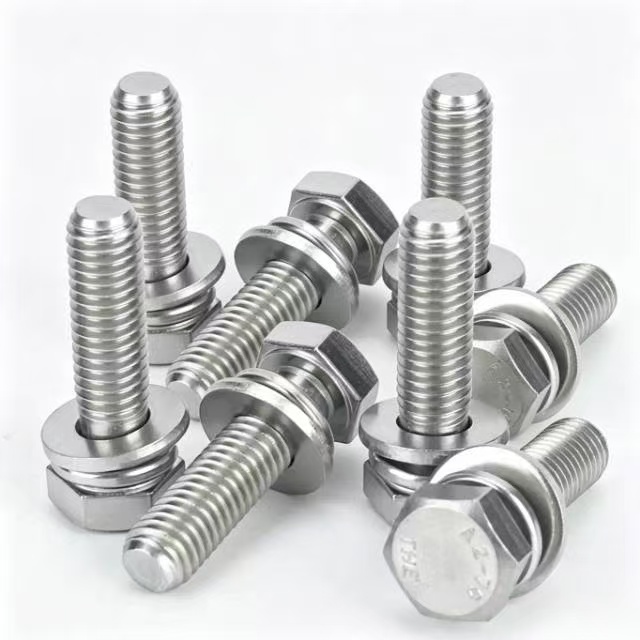
This product is a stainless steel pre-assembled three-piece combination bolt (also known as a SEMS screw, washer-assembled bolt, or combination screw) consisting of a stainless steel bolt, a spring washer (split lock washer), and a flat washer (plain washer) that are factory pre-assembled into a single captive unit. The washers are retained on the bolt shank by the major diameter of the thread, which is larger than the washer hole, allowing free spinning without detachment — this is achieved by inserting the washers before thread rolling.
The product is available in SS304 (A2-70) and SS316 (A4-70) austenitic stainless steel, with both external hex head and internal hex socket head configurations. Standard sizes range from M3 to M12 (M14–M36 available on request), conforming to GB/T 9074.13 (external hex combination bolt), GB/T 9074.17, and equivalent international standards.
The captive washer design is the defining feature of this product. Unlike loose washer assemblies where washers can be lost during transport or handling, the SEMS design ensures that the spring washer and flat washer remain permanently attached to the bolt — increasing work efficiency by eliminating the need to insert a washer and the problem of dropping the washer. This provides several operational advantages: faster assembly (no separate washer handling), reduced parts count (one SKU instead of three), elimination of missing washer defects in automated and manual assembly lines, and consistent preload because the correct washer combination is always present.
The spring washer provides locking action to prevent loosening under vibration, while the flat washer distributes the clamping load over a larger bearing area and protects the mating surface from damage. Together, they form a complete fastening solution in a single unit.
Material & Grade
Parameter SS304 (A2-70) SS316 (A4-70)
Material AISI 304 / 06Cr19Ni10 austenitic stainless steel AISI 316 / 022Cr17Ni12Mo2 austenitic stainless steel
Grade A2-70 per ISO 3506-1 A4-70 per ISO 3506-1
Chemical Composition C ≤ 0.08%, Mn ≤ 2.0%, Si ≤ 0.75%, Cr 18.0–20.0%, Ni 8.0–10.5%, S ≤ 0.03%, P ≤ 0.045% C ≤ 0.08%, Mn ≤ 2.0%, Si ≤ 0.75%, Cr 16.0–18.0%, Ni 10.0–14.0%, Mo 2.0–3.0%, S ≤ 0.03%, P ≤ 0.045%
Tensile Strength (σb) ≥ 700 MPa ≥ 700 MPa
Yield Strength (σ0.2) ≥ 450 MPa ≥ 450 MPa
Elongation (δ5) ≥ 40% ≥ 40%
Hardness ≤ 187 HRB / ≤ 200 HB ≤ 187 HRB / ≤ 200 HB
Corrosion Resistance Good general corrosion resistance Superior chloride and pitting resistance
Magnetic Permeability Non-magnetic (slightly magnetic when cold worked) Non-magnetic
SS304 (A2-70) is a general-purpose austenitic stainless steel offering excellent corrosion resistance, good cold-working properties, and reliable performance across a wide temperature range. It is the most widely specified stainless steel grade for fasteners in industrial, construction, and equipment applications.
SS316 (A4-70) contains 2–3% molybdenum, which provides significantly better resistance to chlorides and pitting corrosion — making A4 the preferred choice for coastal, marine, and chemical processing applications. For the Middle East, SS316 (A4-70) is strongly recommended for any outdoor or coastal application.
The A2-70 / A4-70 designation indicates cold-worked austenitic stainless steel with a minimum tensile strength of 700 MPa, making it suitable for moderate-load structural and mechanical connections.
Standards & Specifications
Parameter Details
Product Type Three-Piece Combination Bolt / SEMS Screw / Washer-Assembled Bolt
Standards GB/T 9074.13 (external hex combination bolt) / GB/T 9074.17 / GB/T 9074.4 / GB/T 9074.8 / DIN 912 + washer assembly / ASME B18.13.1M
Thread Size M3, M4, M5, M6, M8, M10, M12 (M14–M36 on request)
Thread Pitch M3×0.5, M4×0.7, M5×0.8, M6×1.0, M8×1.25, M10×1.5, M12×1.75
Length Range 5 mm – 90 mm (standard); custom lengths available
Thread Tolerance 6g (metric)
Washer Configuration One spring washer (lock washer) + one flat washer, factory pre-assembled
Surface Finish Plain / Passivated (natural stainless) / Polished
Product Grade A
GB/T 9074.13-1988 specifies external hexagon head bolts with spring washer and flat washer assemblies, with thread sizes from M3 to M12 and lengths from 5 mm to 90 mm. The standard defines three common configurations: GB/T 9074.13 (external hex), GB/T 9074.4 (cross recessed large pan head), and GB/T 9074.8 (cross recessed small pan head).
GB/T 9074.17 covers external hex combination bolts with larger flat washers, providing a wider bearing surface for applications with soft or oversized holes.
ASME B18.13.1M-2011 covers metric SEMS for through-hardened machine screws in Property Classes 8.8, 9.8, and 10.9 and case-hardened tapping screws from 5 mm to 12 mm nominal diameter, providing dimensional and mechanical requirements for captive washer assemblies.
Key Dimensions (Reference — External Hex, GB/T 9074.13)
Thread Size (d) Pitch (P) mm Width Across Flats (s) mm Head Height (k) mm Flat Washer OD (mm) Flat Washer Thickness (mm)
M3 0.5 5.5 2.0 7 0.5
M4 0.7 7.0 2.8 9 0.8
M5 0.8 8.0 3.5 10 1.0
M6 1.0 10.0 4.0 12 1.6
M8 1.25 13.0 5.3 16 1.6
M10 1.5 16.0 6.4 20 2.0
M12 1.75 18.0 7.5 24 2.5
All dimensions are in accordance with GB/T 9074.13 / GB/T 9074.17 standards. Washer dimensions per DIN 125 (flat) and DIN 127 (spring).
Hexagon head width across flats reference values for common sizes: M4 = 6.78 mm, M5 = 8.75 mm, M6 = 10.71 mm, M8 = 13.64 mm.
Mechanical Properties (Reference — A2-70 / A4-70)
Property A2-70 (SS304) A4-70 (SS316)
Tensile Strength ≥ 700 MPa ≥ 700 MPa
Yield Strength (0.2% offset) ≥ 450 MPa ≥ 450 MPa
Elongation ≥ 40% ≥ 40%
Hardness ≤ 187 HRB ≤ 187 HRB
Service Temperature Range −196°C to +800°C −196°C to +800°C
Salt Spray Resistance ≥ 500 hours ≥ 1,000 hours
Both A2-70 and A4-70 grades achieve a minimum tensile strength of 700 MPa and a 0.2% proof stress of 450 MPa. SS304 and SS316 combination bolts maintain their mechanical properties across a wide temperature range from cryogenic (−196°C) to elevated (+800°C) temperatures, making them suitable for both low-temperature LNG applications and high-temperature process equipment.
Applications
Stainless steel combination bolts (SEMS screws) are widely used across industries:
Electrical & Electronic Equipment — Control panels, terminal blocks, equipment chassis, rack mounting, enclosure assembly
HVAC & Plumbing — Ductwork supports, pipe clamps, bracket fastening, sanitary fittings
Food & Pharmaceutical — Sanitary piping systems, hygienic equipment assembly, food processing machinery
Marine & Offshore — Boat fittings, dock hardware, coastal architectural applications (SS316 recommended)
Chemical & Petrochemical — Corrosion-resistant fastening in processing equipment, piping supports
Automotive & Transportation — Interior trim, engine accessories, underbody components
Furniture & Fixtures — Metal furniture assembly, shelving systems, display fixtures
Solar & Renewable Energy — Mounting brackets, panel frames, battery module assembly
General Assembly — Any application where a bolt, spring washer, and flat washer are required together
The primary advantage of combination bolts in high-volume assembly operations is the reduction in part count and handling time. Instead of picking up a bolt, a spring washer, and a flat washer separately, the operator handles a single unit — reducing assembly time, eliminating missing washer defects, and ensuring consistent preload.
Regional insight: In GCC construction and infrastructure projects, combination bolts are widely used for HVAC ductwork, electrical panel assembly, and light structural connections where speed of installation and consistent quality are critical. SS316 combination bolts are particularly common in desalination plants, marine environments, and coastal installations across the Middle East.
Quality Assurance
All products are manufactured under strict quality control procedures in accordance with GB/T 9074.13, GB/T 9074.17, ISO 3506-1, and GB/T 3098.6 standards. Material test certificates (EN 10204 3.1), dimensional inspection reports, and third-party inspection reports can be provided upon request.
Quality control steps performed on each production batch:
Chemical composition verification of the stainless steel material
Tensile testing of the bolt body
Hardness testing of the bolt and spring washer
Washer retention test to confirm the washers remain captive but spin freely
Thread gauge inspection for 6g tolerance compliance
Packaging & Customization
Export Packing: Carton / wooden case / steel pallet
Domestic Packing: Standard corrugated box / plastic bag / bundle
OEM/ODM: Available — custom sizes, head types, washer configurations (spring + flat, spring only, flat only), materials (SS304, SS316, SS316L, SS201), and surface finishes can be produced according to drawings or samples
MOQ: Negotiable
Ordering Information
To place an order or request a quotation, please specify:
Product type — Three-piece combination bolt (bolt + spring washer + flat washer)
Head type — External hex / Internal hex socket / Cross recessed pan head
Standard — GB/T 9074.13 / GB/T 9074.17 / DIN 912 + washer assembly / ASME B18.13.1M
Material grade — SS304 (A2-70) / SS316 (A4-70) / SS316L / SS201
Thread size and pitch — e.g., M6 × 1.0 or M8 × 1.25
Length — Specify total length (e.g., 16 mm, 25 mm, 40 mm)
Washer configuration — Spring + flat (standard) / Spring only / Flat only
Surface finish — Plain / Passivated / Polished
Quantity — With any tolerance for over/under shipment
Certification — EN 10204 3.1 MTC / ISO 3506-1 compliance / SASO (for Saudi Arabia) / EAC (for Kazakhstan)
Special requirements — Marking, packaging, anti-seize application, etc.
FAQ: Stainless Steel Combination Bolts for Central Asia & the Middle East
1. What standards should I specify for stainless steel combination bolts in GCC projects?
Answer: The primary standards for pre-assembled combination bolts in the Gulf region are:
Standard Scope GCC Usage
ASME B18.13.1M Metric SEMS — through-hardened machine screws, Property Classes 8.8, 9.8, 10.9 Metric-spec projects
GB/T 9074.13 External hex combination bolt with spring + flat washer Chinese-origin equipment and projects
GB/T 9074.17 External hex combination bolt with larger flat washer Applications requiring wider bearing surface
DIN 6921 Hexagon flange bolts with washers (concept equivalent) European-spec projects
JIS B 1187 Cross recessed pan head SEMS screws Japanese-origin equipment
ASME B18.13.1M covers metric SEMS for through-hardened machine screws in Property Classes 8.8, 9.8, and 10.9 and case-hardened tapping screws from 5 mm to 12 mm nominal diameter.
GB/T 9074.13 specifies external hexagon head bolts with spring washer and flat washer assemblies, thread sizes M3–M12, lengths 5–90 mm.
Practical guidance: For GCC projects, specify ASME B18.13.1M for metric-spec projects or GB/T 9074.13 / GB/T 9074.17 for general industrial applications. Confirm the project specification before ordering.
2. What are the equivalent GOST standards for Central Asia?
Answer: Central Asian countries operate under the GOST standards system, with the following key standards for combination bolts:
GOST Standard Description International Equivalent
GOST 9066-75 Stud bolts for flange connections (0°C to 650°C) DIN 938 / DIN 939
GOST 22032-76 Studs with threaded ends for general use GB/T 901
GOST 22034-76 Studs with threaded ends, metric thread DIN 938
GOST ISO 8992-2015 Fasteners — General requirements ISO 8992:2005
GOST 1759.0-87 Bolts, screws, studs, nuts — General specifications —
GOST 9066-75 covers single-end and double-end studs for flanged connections in steam and gas turbines, with medium temperatures from 0°C to 650°C. This is the primary Russian/CIS standard for flange bolting applications.
Practical implication: For Kazakhstan and Central Asian projects, ASME B18.13.1M / GB/T 9074.13 combination bolts will generally satisfy GOST 9066-75 requirements for general industrial applications, provided EAC certification and Russian/Kazakh language documentation are included.
3. What certification is required for Kazakhstan and Central Asia?
Answer: Central Asian countries operate under the Eurasian Economic Union (EAEU) certification system.
EAC Certification:
Certification Type Applicability Fastener Coverage
EAC CoC (Certificate of Conformity) High-risk products Railway infrastructure, pressure equipment
EAC DoC (Declaration of Conformity) Medium/low-risk products Fasteners for industrial piping, machinery assembly
GOST-K (National) Products not covered by EAEU regulations Construction materials, building fasteners
EAC certification is the unified conformity assessment system of the EAEU, covering Russia, Belarus, Kazakhstan, Kyrgyzstan, and Armenia. The applicable technical regulation for general fasteners is TR CU 010/2011 (Machinery Safety), and fasteners used in building, furniture, or industrial scenarios that relate to user safety fall within its assessment scope. Bolts, nuts, screws, and rivets are specifically classified as fasteners subject to EAC certification requirements.
GOST-K (Kazakhstan): For construction materials, GOST-K certification may be required under Kazakhstan's Decree No. 435 (Building Safety Technical Regulations). Key requirements include -40°C low-temperature impact testing and Russian/Kazakh language documentation. For fasteners used in building and construction, EAC + GOST-K dual certification is commonly required.
Practical implication: For combination bolts exported to Kazakhstan and Central Asia, EAC DoC under TR CU 010/2011 is typically required. The Russian/Kazakh language documentation and Kazakh agent requirement are critical compliance steps.
4. What certification is required for Saudi Arabia?
Answer: Saudi Arabia requires SABER certification for regulated products, including construction materials and fasteners.
SABER Certification — 2025 Policy Update:
As of January 1, 2025, all goods exported to Saudi Arabia must obtain PCoC (Product Conformity Certificate) and SCoC (Shipment Conformity Certificate) through the SABER system. The SABER platform has been fully integrated with Saudi FASAH customs system, serving as the "digital infrastructure" for Saudi import trade.
Certificate Validity Scope
PCoC (Product Conformity Certificate) 1 year Per product model/type
SCoC (Shipment Conformity Certificate) Per shipment Per batch
SASO requirements for fasteners: Steel fasteners, bolts, and screws are classified as regulated products under SASO technical regulations. For certain HS tariff codes, the requirements have changed from Self Declaration to mandatory PCoC certification. Products must comply with SASO Technical Regulations performance standards including tensile strength, corrosion resistance, and dimensional accuracy.
Documentation requirements:
ISO 9001 quality management system certificate
Saudi standard test reports
Product labels and manuals in Arabic language
Practical implication: For combination bolts exported to Saudi Arabia, PCoC and SCoC through SABER are mandatory. Ensure all technical documentation and product labels are in Arabic. Stainless steel fasteners are increasingly referenced to ASTM F593 and ISO 3506 for compliance verification.
5. Which material grade—304 or 316—should I choose for Middle East applications?
Answer:
Grade Suitable For Not Suitable For
SS304 (A2-70) Indoor industrial, general construction, non-coastal applications, electrical panels Coastal, offshore, marine, chemical, high-chloride environments
SS316 (A4-70) Marine, offshore, desalination, chemical processing, coastal construction, food & pharmaceutical —
For the Middle East, SS316 (A4-70) is strongly recommended as the default grade for any outdoor or coastal application. The region's salt-laden air, high humidity, and chloride exposure cause 304 stainless steel to pit and corrode over time. 316 stainless steel contains 2–3% molybdenum, which provides superior resistance to chloride pitting and crevice corrosion.
GCC field data: In marine and offshore applications, 304 stainless steel has shown visible pitting after relatively short service periods, while 316 achieves significantly better performance. For any application within 10–20 km of the coastline in UAE, Saudi Arabia, Qatar, or Oman, 316 (A4) should be the minimum specification.
Cost consideration: 316 (A4-70) typically costs 30–50% more than 304 (A2-70), but the long-term lifecycle cost favors 316 in coastal environments due to reduced maintenance and replacement costs.
6. What is galling, and how can it be prevented with stainless steel combination bolts?
Answer: Galling (cold welding/seizing) is a common problem when stainless steel nuts or washers are in contact with a stainless steel bolt under high torque. The austenitic structure of 304 and 316 grades makes them particularly prone to this phenomenon, especially in hot environments.
Mitigation strategies:
Apply anti-seize compound — Copper-based or nickel-based anti-seize on threads and washer contact surfaces before assembly
Specify dissimilar materials where permitted — e.g., stainless steel bolt with carbon steel nut, or vice versa
Use controlled surface finishes — Passivated surfaces reduce friction and galling risk
Consider PTFE-coated washers — For critical applications, coated washers eliminate galling risk
Control tightening speed — Slow, steady torque application reduces heat buildup that promotes galling
GCC project specification note: Some GCC project specs explicitly require anti-seize application procedures or mandate coated fasteners to eliminate galling risk in shutdown-critical flanged joints. For stainless steel combination bolts in GCC oil & gas projects, anti-seize and correct finish matter.
7. What documentation is required for GCC import?
Answer:
Document Requirement Level Notes
EN 10204 3.1 Material Test Certificate Standard requirement Chemical composition, tensile, yield, hardness
ISO 3506-1 Compliance Certificate Standard for A2/A4 grades Verifies mechanical properties
SASO / SABER Certificate Required for Saudi Arabia PCoC + SCoC through SABER
ESMA Conformity Required for UAE Certificate of conformity for customs
EAC DoC / GOST-K Required for Kazakhstan Per TR CU 010/2011 and Decree No. 435
Packing List Standard With batch identification matching certificates
UAE specific: ESMA requires that imported fasteners meet recognized international standards and carry appropriate conformity documentation.
Saudi Arabia specific: Since 2019, all regulated products including construction materials must be registered on the SABER electronic platform. Stainless steel fasteners are classified as medium-risk products, requiring test reports, technical documents, and factory inspection.
8. What are the most common sizes ordered in the GCC?
Answer:
Size Typical Application Frequency in GCC
M4–M6 Electrical panels, HVAC, instrumentation, control cabinets Very High
M8–M10 Solar mounting, machinery assembly, general industrial High
M12 Structural connections, heavy equipment, marine hardware Moderate
Regional availability: Combination bolts in M4–M12 are routinely available from UAE and Saudi stockists. Standard lengths range from 6 mm to 90 mm, with custom lengths available on request. SS316 combination bolts are increasingly stocked for coastal and marine applications.
9. What is the lead time and availability in the GCC?
Answer:
Scenario Typical Lead Time
Standard sizes in UAE/Saudi stock Same day to 3 days
Non-stock sizes or grades (SS316, larger sizes) 1–2 weeks
Custom or project quantities 4–6 weeks
Import from China/India 4–6 weeks (plus customs clearance)
Regional availability: Leading UAE suppliers offer stainless steel 304 and 316 fasteners from trusted industrial trading companies offering competitive wholesale pricing and fast delivery across the GCC. Standard sizes are routinely stocked in Dubai and Saudi Arabia.
10. What is the price range for stainless steel combination bolts in the Middle East?
Answer:
Grade / Size Approximate Unit Price (USD)
SS304 M4 $0.05 – $0.15
SS304 M6 $0.10 – $0.25
SS304 M8 $0.15 – $0.40
SS316 M6 $0.15 – $0.35
SS316 M8 $0.25 – $0.55
SS316 M10 $0.40 – $0.85
Factors affecting price:
Material grade — SS316 (A4) is 30–50% higher than SS304 (A2)
Quantity — Bulk orders (10,000+ pieces) receive 15–25% discounts
Certification — EN 10204 3.1 and SASO compliance add 5–10%
Logistics — GCC import duties (5% standard) and freight costs
11. How should stainless steel combination bolts be stored and handled on site?
Answer:
Storage:
Store in a dry, covered area away from direct sunlight and rain
Keep in original packaging until ready for installation
Use desiccant packets in humid coastal environments
Avoid contact with carbon steel surfaces that could cause galvanic corrosion
Handling:
Do not drop or impact — The captive washer assembly can be damaged by impact
Verify washer retention — The washers should spin freely but not detach
Inspect before installation — Reject bolts with damaged washers or surface contamination
Apply anti-seize before assembly to prevent galling
Do not mix bolts from different batches — Maintain batch traceability
12. What is the torque specification for stainless steel combination bolts?
Answer:
Size A2-70 / A4-70 Tightening Torque (N·m) Tightening Torque (ft-lb)
M4 2.5 1.8
M5 5.0 3.7
M6 9.0 6.6
M8 22.0 16.2
M10 43.0 31.7
M12 75.0 55.3
Torque values assume μ = 0.15–0.20 (stainless steel, unlubricated). For anti-seize coated fasteners, the friction coefficient may be reduced, requiring adjusted torque values.
Critical guidance: Always use calibrated torque wrenches and torque to no more than 85–90% of proof load. For stainless steel fasteners, anti-seize compound is strongly recommended to prevent galling and ensure consistent torque-tension relationships.
13. Can stainless steel combination bolts be used in NACE / sour service applications?
Answer: Yes, but with specific qualification requirements. NACE MR0175 / ISO 15156 defines material requirements for equipment exposed to hydrogen sulphide (H₂S) in oil and gas production.
Key requirements for stainless steel combination bolts in sour service:
Requirement Details
Grade SS316 (A4) is typically required; SS304 (A2) is generally not acceptable for sour service
Hardness ≤ 22 HRC — hard limit for austenitic stainless steels
Certification EN 10204 3.1 MTC with NACE compliance statement
Anti-Seize Must be NACE-compliant (halide-free)
GCC oil & gas practice: Major operators such as Saudi Aramco and ADNOC mandate NACE MR0175 compliance with full mill test reports and traceability documentation for critical flange joints. For sour service, specify SS316 (A4-70) or Duplex/Super Duplex grades rather than standard SS304.
Note: The spring washer in a combination bolt is a hardened component. For sour service, verify that the spring washer also meets NACE hardness requirements (≤ 22 HRC).
14. What is the difference between a combination bolt and a standard bolt with loose washers?
Answer:
Feature Combination Bolt (SEMS) Standard Bolt + Loose Washers
Part Count 1 unit (bolt + spring washer + flat washer) 3 separate parts
Assembly Time Fast — single handling Slower — multiple handling
Missing Parts Risk Zero — washers captive High — washers can be lost or omitted
Preload Consistency High — correct washer always present Variable — depends on operator
Storage & Logistics Single SKU Three SKUs
Best For High-volume assembly, automated lines Low-volume, field assembly
Combination bolts are preferred in high-volume assembly operations where the reduction in part count, handling time, and missing-part defects outweighs the higher unit cost. In GCC automotive, electrical, and HVAC assembly operations, SEMS screws are the standard choice.
15. What is the difference between GB/T 9074.13 and GB/T 9074.17?
Answer:
Feature GB/T 9074.13 GB/T 9074.17
Head Type External hex / Cross recessed hex External hex
Washer Type Standard spring + flat washer Larger diameter flat washer
Bearing Surface Standard Wider — distributes load over larger area
Typical Application General assembly, electrical, HVAC Soft materials, oversized holes, sheet metal
Size Range M3–M12 M5–M10
GB/T 9074.13 specifies external hexagon head bolts with spring washer and flat washer assemblies, thread sizes M3–M12, lengths 5–90 mm.
GB/T 9074.17 covers external hex combination bolts with larger flat washers, providing a wider bearing surface for applications with soft or oversized holes.
Practical guidance: For general assembly applications, specify GB/T 9074.13. For applications with soft materials (aluminum, plastics) or oversized holes, specify GB/T 9074.17 with the larger flat washer.
16. What are the common causes of combination bolt failure in Middle East site conditions?
Answer:
Failure Mode Root Cause Prevention
Galling/seizing Stainless-on-stainless contact without anti-seize Apply NACE-compliant anti-seize compound before assembly
Washer detachment Thread major diameter too small to retain washer Verify washer retention before installation
Spring washer flattening Over-torque; washer compressed beyond elastic limit Torque to specification; replace flattened washers
Corrosion pitting (304 grade) Coastal/chloride exposure with A2 grade Specify A4 (316) for all outdoor/coastal applications
Galvanic corrosion Contact with dissimilar metals in chloride environment Isolate with washers; specify SS316 for coastal
Thread stripping Over-torque or mismatched thread class Verify thread pitch (metric coarse vs. fine) and use calibrated torque wrench
Critical field warning: If a spring washer flattens or fractures days or weeks after installation, it is almost certainly a hydrogen embrittlement or over-torque failure. Quarantine the batch and verify the installation torque and material certificates with the supplier.
17. What information should be included in an RFQ for stainless steel combination bolts in the GCC?
Answer: A complete RFQ should specify:
Standard: ASME B18.13.1M / GB/T 9074.13 / GB/T 9074.17 / DIN 912 + washer assembly
Head type: External hex / Internal hex socket / Cross recessed pan head
Material grade: SS304 (A2-70) / SS316 (A4-70) / SS316L / SS201
Thread size and pitch: e.g., M6 × 1.0 or M8 × 1.25
Length: Specify total length (e.g., 16 mm, 25 mm, 40 mm)
Washer configuration: Spring + flat (standard) / Spring only / Flat only / Large flat washer (GB/T 9074.17)
Surface finish: Plain / Passivated / Polished
Anti-seize: NACE-compliant anti-seize required? (Yes/No)
Quantity: With any tolerance for over/under shipment
Certification: EN 10204 3.1 MTC / ISO 3506-1 compliance / SASO (for Saudi Arabia) / EAC DoC + GOST-K (for Kazakhstan)
Special requirements: Marking, packaging, washer retention test reports
Common RFQ mistake: Specifying only "M6 stainless steel combination bolt" without stating the standard, material grade, washer configuration, and certification requirements. This creates ambiguity that can lead to unsuitable substitutions — particularly when SS304 is supplied instead of SS316 for a coastal application, or when the washer configuration does not match the project requirement (e.g., spring + flat vs. flat only).


