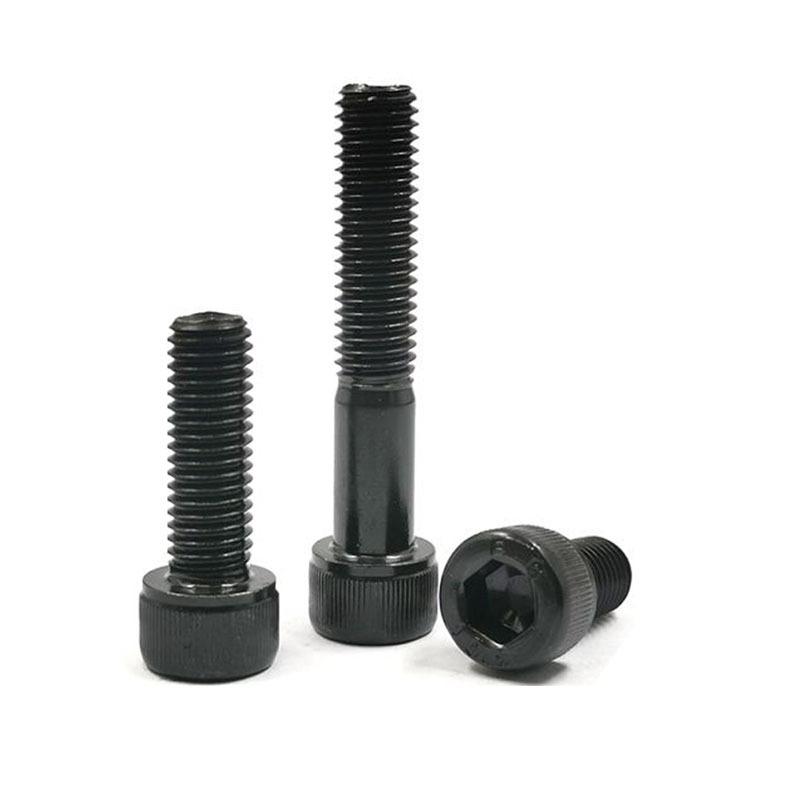
Essential details
Volume:0.35 m³
MOQ:200起订
G.W:0.35 kg
Lead time:1周内
Size:L(7)*W(7)*H(7) cm
N.W:0.062 kg
Product Introduction
Product Overview
This product is a high-strength hex socket head cap screw (also known as an Allen bolt, socket head screw, or cup head screw), manufactured from medium carbon steel (Grade 8.8) or alloy steel (Grade 12.9) and finished with black oxide surface treatment. The screw features a cylindrical head with a hexagonal socket drive, conforming to DIN 912 / ISO 4762 dimensional standards. Standard sizes include M8, M10, M12, and M16, with additional sizes from M3 to M36 available on request.
The Grade 12.9 designation indicates a minimum tensile strength of 1,220 MPa — the highest standard strength grade for metric fasteners — making these screws suitable for the most demanding high-tensile applications in machinery, automotive, mold/die tooling, and heavy equipment. The hexagonal socket drive allows for higher torque transmission than external hex or Phillips drives, enables compact head profiles for recessed applications, and provides precise alignment during installation.
The black oxide finish provides a sleek, oil-free black appearance while offering mild corrosion resistance for indoor and protected environments. It is the standard finish for socket head cap screws and is widely specified in machinery, tooling, and precision assembly applications.
Product Type & Design
Feature Description
Product Type Hex Socket Head Cap Screw / Allen Bolt / Cup Head Screw
Head Type Cylindrical head with hexagonal socket drive
Thread Configuration Full thread or partial thread (DIN 912 covers both)
Thread Direction Right-hand (left-hand available on request)
Thread Tolerance 6g (metric)
Drive Type Hexagonal socket (Allen key)
The cylindrical head with internal hex socket is the defining feature of this product. Unlike external hex heads, the socket drive allows the screw to be installed in recessed or counterbored holes where an external wrench cannot fit. The internal hex drive also provides higher torque transmission with a smaller wrench size, making these screws ideal for tight spaces and precision assemblies.
Material & Strength Grades
Grade Material Tensile Strength (min.) Yield Strength (min.) Hardness Typical Applications
8.8 Medium carbon steel (45#, 10B21) ≥800 MPa ≥640 MPa 250–320 HV General machinery, structural connections
12.9 Alloy steel (42CrMo, SCM435) ≥1,220 MPa ≥1,100 MPa 385–435 HV Mold/die tooling, CNC spindles, robotics, turbine components
Grade 8.8 socket head cap screws are manufactured from medium carbon steel (typically 10B21 boron steel) through cold heading followed by quenching and tempering. The "8.8" designation indicates a minimum tensile strength of 800 MPa and a yield-to-tensile ratio of 0.8.
Grade 12.9 socket head cap screws are manufactured from quenched and tempered alloy steel (typically 42CrMo or SCM435) and achieve a minimum tensile strength of 1,220 MPa with hardness of 38–44 HRC (approximately 385–435 HV). Grade 12.9 provides approximately 50% higher tensile strength than Grade 8.8 and approximately 17% higher than Grade 10.9, making it the preferred choice for critical high-stress applications where maximum load capacity and compact head profile are required.
Material composition for 12.9 grade: Typically includes 0.37–0.41% carbon, 0.90–1.20% chromium, and 0.15–0.30% molybdenum for through-hardening capability.
Standards & Specifications
Parameter Details
Product Type Hex Socket Head Cap Screw (Cylindrical Head)
Standard DIN 912 / ISO 4762 / ASME B18.3 / BS 4168 / JIS B 1176
Thread Size M8, M10, M12, M16 (standard); M3–M36 available
Thread Pitch M8×1.25, M10×1.5, M12×1.75, M16×2.0
Length Range 10 mm – 300 mm (customizable)
Thread Tolerance 6g (metric)
Material Carbon steel: 45#, 10B21; Alloy steel: 42CrMo, SCM435, 35CrMo
Surface Finish Black Oxide (standard) / Zinc Plated / Plain / Dacromet
Product Grade A
DIN 912 is the classic German standard for hex socket head cap screws, covering metric coarse threads from M1.6 to M64 in product grade A. ISO 4762 is the international equivalent and has replaced DIN 912 as the primary standard. DIN 912 and ISO 4762 screws are dimensionally interchangeable — they share the same dimensions and properties, with ISO 4762 incorporating updated wrench-size tolerances and the addition of stainless steel grades A3–A5. DIN 912 is listed as "Standard withdrawn" on supplier platforms, confirming the transition to ISO 4762.
ASME B18.3 covers inch-series socket head cap screws and metric series socket head cap screws per ANSI/ASME B18.3.1M, in sizes from 1.6 mm to 48 mm.
Key Dimensions (Reference — DIN 912 / ISO 4762)
Thread Size (d) Pitch (P) mm Head Diameter (S) mm Head Thickness (k) mm Hex Socket (B) mm
M6 1.0 9.8–10.2 5.7–6.0 5
M8 1.25 12.7–13.3 7.6–8.0 6
M10 1.5 15.7–16.3 9.6–10.0 8
M12 1.75 17.7–18.3 11.6–12.0 10
M16 2.0 23.7–24.3 15.6–16.0 14
All dimensions are in accordance with DIN 912 / ISO 4762 standards. Head diameter and thickness tolerances are shown as min–max ranges.
Mechanical Properties (Reference)
Size Grade Tensile Strength (MPa) Yield Strength (MPa) Proof Load (MPa) Hardness
M8 8.8 800 640 580 250–320 HV
M8 12.9 1,220 1,100 970 385–435 HV
M10 12.9 1,220 1,100 970 385–435 HV
M12 12.9 1,220 1,100 970 385–435 HV
M16 12.9 1,220 1,100 970 385–435 HV
Grade 12.9 socket head cap screws achieve a minimum tensile strength of 1,220 MPa and a minimum proof load of 970 MPa. The Rockwell C hardness typically ranges from 39 to 44 HRC. The maximum operating temperature for black oxide Grade 12.9 screws is approximately 300°C.
Mechanical property verification: For 12.9 grade screws, tensile testing, hardness testing, and impact testing are performed on each production batch. Materials and mechanical requirements reference ISO 898-1, with thread specifications per ISO 724 and ISO 965-1.
Black Oxide Surface Treatment
Parameter Specification
Coating Thickness 0.5–1.5 μm
Salt Spray Resistance 24–96 hours (to red rust)
Appearance Deep black, uniform matte finish
Corrosion Mechanism Barrier protection (no sacrificial protection)
Maximum Service Temperature ~300°C (continuous)
Lubricity Enhanced — black oxide provides improved lubricity
Recommended Environment Indoor, protected, oiled or greased assemblies
Black oxide is a conversion coating produced by chemical reaction between the steel surface and oxidizing salts. It provides a sleek black appearance and mild corrosion resistance for indoor and protected environments. The coating is thin (approximately 0.5–1.5 μm) and porous, which means it provides only modest corrosion resistance compared to zinc plating or hot-dip galvanizing. The coating achieves a neutral salt spray resistance of approximately 24 to 96 hours.
Advantages of black oxide:
Attractive black finish — preferred for machinery, tooling, and precision equipment
Enhanced lubricity — reduces friction during tightening and improves torque-tension consistency
No white corrosion — preferred coating for the electronics industry as white corrosion can cause electrical shorts
No hydrogen embrittlement risk — unlike electroplating, black oxide does not introduce hydrogen into the steel
Dimensional stability — thin coating does not affect thread fit or require re-tapping
Important note for Grade 12.9: Black oxide is the preferred surface treatment for Grade 12.9 socket head cap screws precisely because it avoids the hydrogen embrittlement risk associated with electroplating. Grade 12.9 screws have hardness above 320 HV and are particularly susceptible to hydrogen embrittlement when electroplated. Industry guidance explicitly states that Grade 12.9 screws typically avoid electroplating due to hydrogen embrittlement risks — hydrogen absorption during plating can cause sudden, unpredictable fractures under stress even after prolonged use. Instead, these screws undergo a specialized black oxide treatment that provides a sleek, oil-free finish and comparable durability.
Applications
Black oxide hex socket head cap screws are widely used across industries:
Mold & Die Tooling — Mold base assembly, ejector plate fastening, die clamping
CNC Machine Spindles — Spindle mounting, tool holder clamping, fixture assembly
Robotics & Automation — Robot arm joints, linear motion guides, end effector mounting
Automotive & Powertrain — Engine components, transmission housings, chassis connections
Industrial Machinery — Presses, CNC machines, molding equipment, hydraulic systems
Aerospace & Defense — Airframe structural fastening, engine mounts, avionics brackets
Precision Instruments — Medical devices, test equipment, optical instruments
Energy & Power Generation — Turbine components, generator mounting, switchgear assembly
Bicycle & Motorcycle — Stem bolts, brake calipers, disc rotor mounting
The compact cylindrical head allows the screw to be used in recessed or counterbored holes where an external hex head would not fit. The hex socket drive enables higher torque transmission with a smaller wrench size, making these screws ideal for tight spaces and precision assemblies.
Torque Specifications (Grade 12.9, Black Oxide)
Size Recommended Tightening Torque (N·m) Tightening Torque (ft-lb)
M6 10.0 7.4
M8 25.0 18.4
M10 48.0 35.4
M12 86.0 63.4
M16 210.0 154.9
Torque values assume μ = 0.12–0.14 (black oxide, lightly oiled). Black oxide provides enhanced lubricity compared to plain steel, which may reduce the friction coefficient and require adjusted torque values.
Critical guidance: Always use calibrated torque wrenches and torque to no more than 85–90% of proof load. For critical assemblies, validate the tightening method, friction, and preload on the actual joint using ISO 16047 torque-tension testing.
Quality Assurance
All products are manufactured under strict quality control procedures in accordance with ISO 898-1 (mechanical properties of fasteners), ISO 4762 / DIN 912, and ASME B18.3 standards.
Quality control steps performed on each production batch:
Chemical composition verification of the alloy steel material
Tensile testing of the screw body
Hardness testing to confirm 385–435 HV for 12.9 grade
Thread gauge inspection (go/no-go gauges) for 6g tolerance
Visual inspection for surface defects and black oxide coating uniformity
Material test certificates (EN 10204 3.1), dimensional inspection reports, hardness test reports, and third-party inspection reports (SGS, BV, CTI) can be provided upon request.
Packaging & Customization
Export Packing: Carton / wooden case / steel pallet
Domestic Packing: Standard corrugated box / plastic bag / bulk carton
OEM/ODM: Available — custom sizes, thread types (metric / UNC / UNF / BSW), materials (alloy steel, stainless steel), and surface finishes (zinc plated, Dacromet, plain) can be produced according to drawings or samples
MOQ: Negotiable
Ordering Information
To place an order or request a quotation, please specify:
Product type — Hex socket head cap screw (DIN 912 / ISO 4762)
Standard — DIN 912 / ISO 4762 / ASME B18.3
Material — Alloy steel (42CrMo / SCM435 / 35CrMo) / Carbon steel (10B21 / 45#)
Strength grade — 8.8 / 10.9 / 12.9
Thread size and pitch — e.g., M10 × 1.5 or M12 × 1.75
Length — Specify total length (e.g., 25 mm, 40 mm, 60 mm)
Surface finish — Black oxide (standard) / Zinc plated / Dacromet / Plain
Quantity — With any tolerance for over/under shipment
Certification — EN 10204 3.1 MTC / ISO 898-1 compliance / SASO (for Saudi Arabia) / EAC DoC (for Kazakhstan)
Special requirements — Thread tolerance, marking, packaging, torque-tension test reports, etc.
FAQ: Black Oxide Hex Socket Head Cap Screws for Central Asia & the Middle East
1. What standards should I specify for socket head cap screws in GCC projects?
Answer: The primary standards for hex socket head cap screws in the Gulf region are:
Standard Scope GCC Usage
ISO 4762 Hex socket head cap screws — metric International standard; most widely accepted
DIN 912 Hex socket head cap screws — metric German standard; functionally equivalent to ISO 4762
ASME B18.3 Socket cap screws — inch series US-spec projects
ASME B18.3.1M Metric series socket head cap screws, 1.6 mm to 48 mm Metric-spec US projects
JIS B 1176 Hex socket head cap screws — Japanese Japanese-origin equipment
ISO 4762 has replaced DIN 912 as the primary international standard. DIN 912 is listed as "Standard withdrawn" on supplier platforms, though products continue to be manufactured and sold to the DIN 912 specification for legacy compatibility. DIN 912 and ISO 4762 are dimensionally interchangeable and functionally equivalent.
ASME B18.3.1M contains complete general and dimensional data for metric series hexagon socket head cap screws in sizes from 1.6 mm to 48 mm recognized as American National Standard.
Practical guidance: For GCC projects, specify ISO 4762 / DIN 912 as the baseline for metric projects, or ASME B18.3 for US-spec projects. Always confirm the project specification before ordering.
2. What are the equivalent GOST standards for Central Asia?
Answer: Central Asian countries operate under the GOST standards system, with the following key standards for hex socket head cap screws:
GOST Standard Description International Equivalent
GOST 11738-84 Hex socket head cap screws, product grade B DIN 912 / ISO 4762
GOST R ISO 4762-2012 Russian national standard for hex socket head cap screws ISO 4762:2004
GOST R ISO 3506-1-2009 Mechanical properties of corrosion-resistant stainless steel fasteners ISO 3506-1
GOST 11738-84 covers hex socket head cap screws with cylindrical head and hex socket drive, metric threads from M3 to M24, product grade B. Suppliers in Kazakhstan (Shymkent, Pavlodar, Astana) routinely stock screws to GOST 11738-84 / DIN 912 / DIN EN ISO 4762-2004 with zinc plating or black oxide in grades 8.8 and 10.9.
GOST R ISO 4762-2012 is the Russian national adoption of ISO 4762, specifying characteristics of hex socket head cap screws with coarse threads from M1 upward.
Practical implication: For Kazakhstan and Central Asian projects, ISO 4762 / DIN 912 socket head cap screws will satisfy GOST 11738-84 requirements, provided the thread size is within the M3–M24 range and material certification confirms the specified strength grade.
3. What certification is required for Kazakhstan and Central Asia?
Answer: Central Asian countries operate under the Eurasian Economic Union (EAEU) certification system, with additional national requirements.
EAC Certification:
Certification Type Applicability Fastener Coverage
EAC DoC (Declaration of Conformity) Medium/low-risk products Fasteners for industrial piping, machinery assembly under TR CU 010/2011
EAC CoC (Certificate of Conformity) High-risk products Railway infrastructure, pressure equipment
GOST-K (National) Products not covered by EAEU regulations Construction materials, building fasteners
TR CU 010/2011 (Machinery Safety) is the applicable technical regulation for hex socket head cap screws used in industrial machinery, mechanical equipment assembly, and structural connections. Fasteners — bolts, nuts, screws, rivets — are specifically classified as products subject to EAC certification requirements.
GOST-K Certification (Kazakhstan):
For construction materials and building fasteners, GOST-K certification is required under Kazakhstan's Decree No. 435 (Building Safety Technical Regulations). Key requirements include:
Requirement Details
−40°C Low-Temperature Impact Testing Mandatory — all construction materials must pass impact testing at −40°C; cannot be waived
Russian/Kazakh Language Documentation Product labels, installation manuals, and certificates must be in Russian and/or Kazakh
GOST-K Mark + Dynamic QR Code From 2025, GOST-K marking with dynamic QR code is mandatory
Kazakh Agent Required Non-EAEU manufacturers must appoint a Kazakh representative with notarized translations
Practical implication: For hex socket head cap screws exported to Kazakhstan and Central Asia, EAC DoC under TR CU 010/2011 is typically required. For construction applications, GOST-K certification with −40°C impact testing may also be required.
4. What certification is required for Saudi Arabia?
Answer: Saudi Arabia requires SABER certification for regulated products, including construction materials and fasteners.
SABER Certification — 2025 Policy Update:
As of January 1, 2025, all goods exported to Saudi Arabia must obtain PCoC (Product Conformity Certificate) and SCoC (Shipment Conformity Certificate) through the SABER system. The previous "Undertaking Letter" customs clearance method has been completely abolished. Certificates must be obtained before vessel arrival — post-arrival applications are invalid, lead to clearance refusal, and may incur fines and demurrage charges.
Certificate Validity Scope
PCoC (Product Conformity Certificate) 1 year Per product model/type; reusable for multiple shipments
SCoC (Shipment Conformity Certificate) Per shipment Per batch; must be obtained before vessel arrival
Applicable technical regulations: Hex socket head cap screws fall under Technical Regulation for Building Materials Part 1: Metallic and Alloy Components for Buildings and Construction. Fasteners are specifically included in the regulated product list, with concrete, rebar, steel plates, paint, and screws all falling within the mandatory certification scope.
Risk classification: Building metal and alloy components are classified as medium-risk (Type 1a / Type 3) , requiring test reports, technical documents, and factory inspection with annual surveillance.
Key requirements:
Local importer required: Chinese manufacturers cannot apply directly; the Saudi importer must initiate the application on the SABER platform.
Arabic or bilingual product labels are mandatory.
HS Code updates: SABER platform HS codes have been continuously updated since 2025. After new codes are implemented, existing certificates become invalid, and applicants must re-submit.
Practical implication: For hex socket head cap screws exported to Saudi Arabia, PCoC and SCoC through SABER are mandatory as of 2025. Ensure all technical documentation and product labels are in Arabic or bilingual. The PCoC certificate should be obtained before shipment.
5. Why is hydrogen embrittlement critical for Grade 12.9 socket head cap screws?
Answer: This is the single most important safety issue for Grade 12.9 socket head cap screws.
The mechanism: Hydrogen embrittlement occurs when atomic hydrogen is absorbed into the steel during acid pickling or electroplating. The hydrogen is trapped in the hard microstructure (Grade 12.9 has hardness above 320 HV) and is driven to crack tips by the tensile stress of preload, causing delayed brittle fracture — the screw breaks days or weeks after tightening, with no overload warning.
The risk of hydrogen embrittlement increases with the material strength properties, hence especially 10.9 and 12.9 bolt grades are at risk when electroplated. The most common sources of hydrogen in the manufacturing phase are acid pickling and electroplating processes. The absorbed hydrogen can be released by a process called baking — heat treatment of the fastener after electroplating to release absorbed hydrogen. However, baking is not considered to be a reliable method of releasing all the absorbed hydrogen, hence hydrogen embrittlement is unavoidable with the electroplating process.
Why black oxide is the preferred finish for 12.9: Grade 12.9 screws typically avoid electroplating due to hydrogen embrittlement risks. Instead, these screws undergo a specialized black oxide treatment that provides a sleek, oil-free finish and comparable durability without the risk of hydrogen absorption.
GCC procurement implication: For any Grade 12.9 socket head cap screw specified for structural, offshore, or safety-critical applications in the Middle East, black oxide or zinc-flake (Dacromet/Geomet) coating is strongly preferred over electroplating. Black oxide eliminates hydrogen embrittlement risk entirely while providing adequate corrosion protection for indoor and protected environments. For coastal or outdoor applications, Dacromet should be specified for corrosion protection without hydrogen embrittlement risk.
6. What are the most common applications for socket head cap screws in the Middle East?
Answer:
Application Typical Grade Size Range Why Socket Head
Mold & die tooling 12.9 M6–M16 Maximum clamping force in compact envelope
CNC machine spindles 12.9 M8–M20 High preload, precision alignment
Robotics & automation 12.9 M5–M12 Compact head profile, high torque transmission
Turbine components 12.9 M12–M24 Critical high-stress connections
Oil & gas valve assembly 10.9/12.9 M8–M20 High-pressure service, compact design
Pump & compressor mounting 10.9 M10–M24 Vibration resistance, high preload
Electrical panels & instrumentation 8.8 M4–M8 Compact, reliable fastening
Grade 12.9 socket head cap screws are the gold standard for high-performance mechanical assembly due to their combination of maximum strength, compact head design, and reliable torque transmission via internal hex drive.
Regional insight: In the Middle East, socket head cap screws are particularly common in oil & gas valve and instrument assembly, mold/die tooling for plastic and metal forming, and CNC machine maintenance. For coastal and offshore applications, Dacromet-coated socket head cap screws are increasingly specified over black oxide to provide corrosion protection without hydrogen embrittlement risk.
7. What documentation is required for GCC import?
Answer:
Document Requirement Level Notes
EN 10204 3.1 Material Test Certificate Standard requirement Chemical composition, tensile, yield, hardness
ISO 898-1 Compliance Certificate Standard requirement Verifies mechanical properties per property class
SASO / SABER Certificate Required for Saudi Arabia PCoC + SCoC through SABER
ESMA Conformity Required for UAE Certificate of conformity for customs
EAC DoC / GOST-K Required for Kazakhstan Per TR CU 010/2011 and Decree No. 435
Packing List Standard With batch identification matching certificates
Saudi Arabia specific: Hex socket head cap screws are classified as building metal and alloy components under SASO Technical Regulations. The 2025 policy requires full mandatory certification through SABER. Arabic or bilingual product labels are mandatory.
UAE specific: ESMA requires that imported fasteners meet recognized international standards and carry appropriate conformity documentation.
8. What are the most common sizes ordered in the GCC?
Answer:
Size Typical Application Frequency in GCC
M4–M6 Instrumentation, small machinery, electrical panels High
M8–M10 Machine tools, pump/valve assembly, general machinery Very High
M12 Mold/die tooling, structural connections, machinery Very High
M16 Heavy machinery, turbine components, offshore equipment High
M20+ Large machinery, bridge connections, power generation Moderate
Regional availability: Grade 12.9 socket head cap screws in M4–M24 are routinely available from UAE and Saudi stockists, with M8–M16 being the highest-volume sizes. Standard lengths range from 10 mm to 300 mm, with custom lengths available on request.
9. What is the lead time and availability in the GCC?
Answer:
Scenario Typical Lead Time
Standard sizes (M4–M20) in UAE/Saudi stock Same day to 3 days
Non-stock sizes or grades (M24+, Dacromet) 1–2 weeks
Custom or project quantities 4–6 weeks
Import from China/India/Europe 4–6 weeks (plus customs clearance)
Regional availability: Grade 12.9 socket head cap screws in M4–M20 are routinely stocked in Dubai and Saudi Arabia for immediate delivery. Black oxide finish is the standard stock finish. Dacromet-coated variants are increasingly stocked for coastal and offshore applications.
10. What is the price range for socket head cap screws in the Middle East?
Answer:
Grade / Size Approximate Unit Price (USD)
Grade 8.8 M6 $0.05 – $0.15
Grade 8.8 M8 $0.08 – $0.20
Grade 12.9 M6 $0.10 – $0.25
Grade 12.9 M8 $0.15 – $0.35
Grade 12.9 M10 $0.25 – $0.55
Grade 12.9 M12 $0.40 – $0.85
Grade 12.9 M16 $0.80 – $1.80
Factors affecting price:
Strength grade — Grade 12.9 is 30–50% higher than 8.8
Material — Alloy steel (42CrMo, SCM435) required for 12.9 adds cost over carbon steel
Coating — Dacromet adds 25–40% over black oxide
Quantity — Bulk orders (10,000+ pieces) receive 15–25% discounts
Certification — EN 10204 3.1 and SASO compliance add 5–10%
Logistics — GCC import duties (5% standard) and freight costs
11. What is the torque specification for Grade 12.9 socket head cap screws?
Answer:
Size Grade 12.9 Tightening Torque (N·m) Tightening Torque (ft-lb)
M6 10.0 7.4
M8 25.0 18.4
M10 48.0 35.4
M12 86.0 63.4
M16 210.0 154.9
Torque values assume μ = 0.12–0.14 (black oxide, lightly oiled). Black oxide provides enhanced lubricity, which may reduce the friction coefficient compared to plain steel. For critical assemblies, validate torque values through ISO 16047 torque-tension testing.
Critical guidance: Always use calibrated torque wrenches and torque to no more than 85–90% of proof load. For critical assemblies, validate the tightening method, friction, and preload on the actual joint using ISO 16047 torque-tension testing.
12. Can Grade 12.9 socket head cap screws be used in NACE / sour service applications?
Answer: No — Grade 12.9 socket head cap screws are generally NOT suitable for NACE MR0175 / ISO 15156 sour service applications without specific qualification.
NACE MR0175 / ISO 15156 requires:
Hardness ≤ 235 HBW (approximately 22 HRC) — this is a hard limit
Grade 12.9 screws have hardness of 385–435 HV (approximately 38–44 HRC) , which far exceeds the NACE hardness limit
For sour service (H₂S-containing environments):
Base material must independently satisfy NACE MR0175 / ISO 15156 chemical and hardness limits
Common compliant materials include A193 B7M (alloy steel), B8M Class 2 (316 stainless), and Duplex 2205 / Super Duplex 2507
GCC oil & gas practice: Major operators such as ADNOC and Saudi Aramco mandate NACE MR0175 compliance with full mill test reports and traceability documentation for critical flange joints. For sour service, specify Duplex or Super Duplex socket head cap screws rather than Grade 12.9.
13. What is the difference between black oxide and zinc plating for socket head cap screws?
Answer:
Property Black Oxide Zinc Plating
Coating Thickness 0.5–1.5 μm 8–12 μm
Salt Spray (to red rust) 24–96 hours 72–144 hours
Hydrogen Embrittlement Risk None High risk for 12.9
Appearance Deep black Blue-white / Clear / Yellow
Lubricity Enhanced Moderate
Thread Fit Impact Minimal Minimal
Recommended Environment Indoor, protected, oiled assemblies Indoor, general industrial
Black oxide is the preferred finish for Grade 12.9 socket head cap screws because it eliminates hydrogen embrittlement risk entirely. Zinc plating provides better corrosion resistance for Grade 8.8 screws but requires post-plating baking for Grade 12.9 to mitigate hydrogen embrittlement risk.
GCC procurement guidance: For indoor, protected applications, specify black oxide — it provides the required lubricity and appearance while eliminating hydrogen embrittlement risk. For outdoor or coastal applications, specify Dacromet or Geomet (zinc-flake) coating, which provides superior corrosion resistance without hydrogen embrittlement risk. For Grade 8.8 only, zinc plating is acceptable for general indoor applications.
14. What is the difference between DIN 912 and ISO 4762?
Answer:
Feature DIN 912 ISO 4762
Status Standard withdrawn Current international standard
Dimensions Same for M1.6–M64 Same; incorporates updated tolerances
Thread Tolerances 6g 6g (default); other classes on request
Stainless Grades A2/A4 (limited) A3–A5 added
Wrench Size Standard Slight tolerance changes for some sizes
Interchangeability Yes — dimensionally interchangeable Yes — dimensionally interchangeable
ISO 4762 has replaced DIN 912 as the primary standard. DIN 912 is listed as "Standard withdrawn" on supplier platforms, though products continue to be manufactured and sold to the DIN 912 specification for legacy compatibility.
Practical guidance: For new GCC projects, specify ISO 4762 as the primary standard. For existing projects or equipment referencing DIN 912, ISO 4762 screws are dimensionally interchangeable and functionally equivalent.
15. How should black oxide socket head cap screws be stored and handled on site?
Answer:
Storage:
Store in a dry, covered area away from direct sunlight and rain
Keep in original packaging until ready for installation
Use desiccant packets in humid environments
For long-term storage (>6 months), apply a light coat of oil to prevent surface rust
Handling:
Inspect for hydrogen embrittlement signs — Brittle fractures often occur under the head or at the first thread, with no visible deformation
Do not exceed recommended torque — Over-torque can trigger delayed fracture in embrittled screws
Use calibrated torque wrenches — Torque to no more than 85–90% of proof load
Replace any screw that has been over-torqued — It does not recover and may fail later
Do not mix screws from different batches — Maintain batch traceability
Important note: Black oxide coating is thin and porous and provides only modest corrosion resistance. For humid or coastal environments, black oxide screws should be oiled or greased to prevent surface rust. For outdoor or coastal applications, specify Dacromet or zinc-flake coating instead.
16. What are the common causes of socket head cap screw failure in Middle East site conditions?
Answer:
Failure Mode Root Cause Prevention
Hydrogen embrittlement Zinc-plated Grade 12.9 without adequate baking Use black oxide or Dacromet coating; verify baking records for zinc-plated
Thread stripping Nut class below bolt class; insufficient engagement Match nut class per ISO 898-2; ensure ≥1×d engagement in steel
Fatigue failure Insufficient preload; loose joint Achieve and verify preload; use hardened washers
Galvanic corrosion Contact with dissimilar metals in chloride environment Isolate with washers; specify Dacromet for coastal
Hex socket rounding Using wrong key size; over-torque Use correct hex key; torque to specification
Surface rust Black oxide coating insufficient for environment Apply oil/grease; use Dacromet for outdoor
Critical field warning: If a Grade 12.9 screw fractures days or weeks after installation with no overload, it is almost certainly a hydrogen embrittlement failure. Do not install additional screws from the same batch — quarantine the batch and verify the coating process and baking records with the supplier.
17. What information should be included in an RFQ for socket head cap screws in the GCC?
Answer: A complete RFQ should specify:
Standard: ISO 4762 / DIN 912 / ASME B18.3
Product type: Hex socket head cap screw (fully threaded / partially threaded)
Material: Alloy steel (42CrMo / SCM435) / Carbon steel (10B21 / 45#)
Strength grade: 8.8 / 10.9 / 12.9
Thread size and pitch: e.g., M10 × 1.5 or M12 × 1.75
Length: Specify total length (e.g., 25 mm, 40 mm, 60 mm)
Surface finish: Black oxide (standard) / Zinc plated / Dacromet / Plain
Coating specification: Salt spray requirement (for Dacromet orders)
Hydrogen embrittlement: For zinc-plated 12.9 — require baking certificate per ISO 4042
Quantity: With any tolerance for over/under shipment
Certification: EN 10204 3.1 MTC / ISO 898-1 compliance / SASO (for Saudi Arabia) / EAC DoC (for Kazakhstan)
Special requirements: Thread tolerance, marking, packaging, torque-tension test reports
Common RFQ mistake: Specifying only "M10 12.9 socket head cap screw" without stating the coating type and coating performance requirement. This creates ambiguity that can lead to unsafe substitutions — particularly when zinc plating is supplied without hydrogen embrittlement relief baking for a Grade 12.9 application. Always specify black oxide or Dacromet for Grade 12.9 screws to eliminate hydrogen embrittlement risk.


